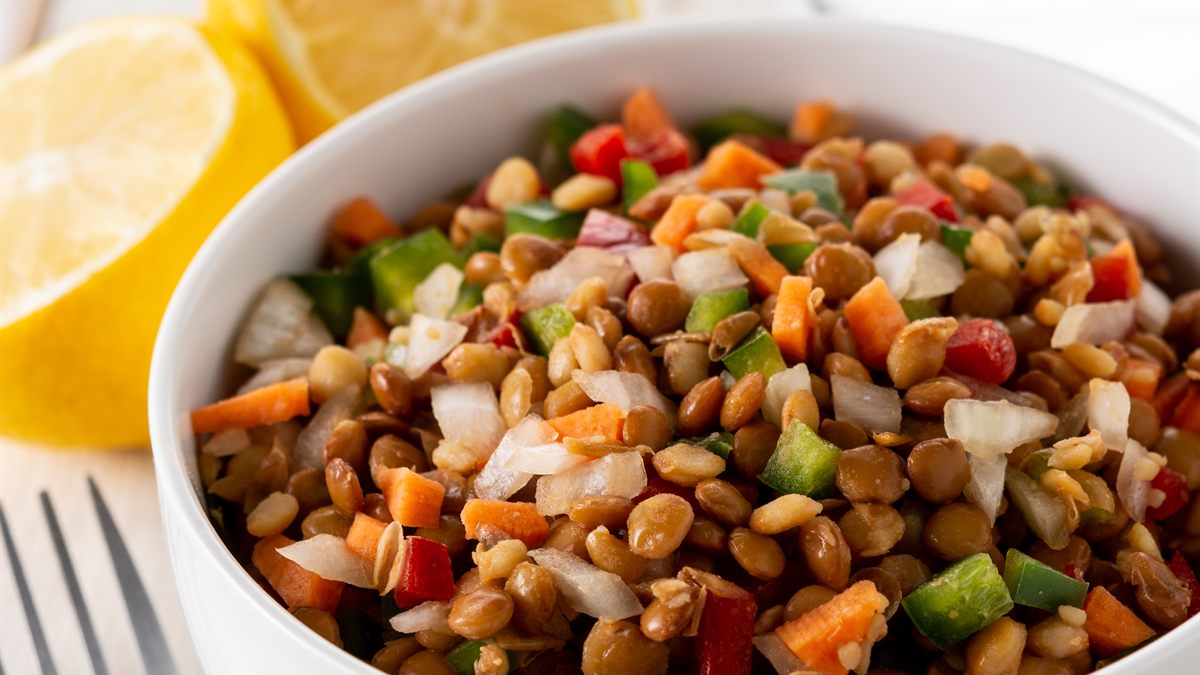
Why good for your mouth? Pulses, vegetables and olive oil are the basis of the Mediterranean eating pattern. In a randomised trial, six weeks of Mediterranean eating reduced bleeding gums with the same amount of plaque. Raw pepper provides plenty of vitamin C, and a high-fibre diet was linked to less periodontitis in a large study. We make the dressing without lemon or vinegar, so no acid on your enamel. ([1] Bartha 2022; [2] Hujoel 2021; [3] Merchant 2006)
Ingredients
250 g green lentils
1 red pepper
1 green pepper
1 red onion
2 carrots
3 tbsp olive oil
½ tsp cumin
Fresh parsley
Salt and pepper
Method
Cook the lentils. Cook the lentils in plenty of water for 20 minutes until tender, then drain and let them cool.
Chop the vegetables. Dice the peppers, onion and carrots.
Mix. Mix the lentils with the vegetables, olive oil, cumin and chopped parsley. Season with salt and pepper.
Let it rest. Leave the salad for 10 minutes so the lentils absorb the flavour.
Made this recipe? What did you think?
No single dish cures gum inflammation. It is about your eating pattern as a whole, alongside good brushing, interdental cleaning and your check-ups.
Sources
[1] Bartha V et al. Effect of the Mediterranean diet on gingivitis: a randomized controlled trial. J Clin Periodontol 2022;49:111-122. pubmed.ncbi.nlm.nih.gov/34818686/
[2] Hujoel PP et al. Bleeding tendency and ascorbic acid requirements: systematic review and meta-analysis of clinical trials. Nutr Rev 2021;79:964-975. pubmed.ncbi.nlm.nih.gov/33517432/
[3] Merchant AT et al. Whole-grain and fiber intakes and periodontitis risk in men. Am J Clin Nutr 2006;83:1395-1400. pubmed.ncbi.nlm.nih.gov/16762952/